


CELL AND CANCER BIOLOGY GROUP
CELL AND CANCER BIOLOGY GROUP
• We investigate the molecular and cellular mechanisms underlying cancer development.
• We focus on cancer biology and the mechanisms of cellular signaling.
• We study how kinases—particularly receptor tyrosine kinases (currently the TAM receptors: TYRO3, AXL, and MER)—drive tumor growth, invasion, and therapy resistance.
RESEARCH FOCUS
Protein kinases are key regulators of signal transduction, controlling virtually all processes essential for proper cellular function. It is estimated that more than 400 human diseases are directly or indirectly associated with protein kinases. Among them, receptor tyrosine kinases (RTKs) play a particularly prominent role in coordinating cellular signaling networks. These transmembrane receptors with intrinsic tyrosine kinase activity transmit extracellular signals into the cell, thereby constituting a critical component of communication between cells as well as between cells and their environment. Dysregulation of RTKs underlies numerous diseases, most notably cancer, making them highly promising and attractive targets for anticancer therapies.
Research conducted in our group aims to elucidate the molecular and cellular processes underlying cancer development and progression that are regulated by kinases, with particular emphasis on RTKs. Currently, our work focuses on uncovering molecular and cellular mechanisms controlled by the receptor tyrosine kinase AXL, which, together with TYRO3 and MER (MERTK), belongs to the TAM receptor family. In adult organisms, TAM receptors are considered important regulators of tissue homeostasis. They are involved in suppressing innate immune responses through the clearance of apoptotic cells via phagocytosis (a process known as efferocytosis). TAM receptors also play roles in viral infections. For example, recent studies have shown that AXL facilitates the entry of viruses such as Zika virus and SARS-CoV-2 into host cells.
Like other RTKs, TAM receptors are implicated in cancer development, with AXL playing a particularly prominent role in the progression of many tumor types. Elevated AXL expression is associated with increased cancer cell invasiveness, a higher risk of metastasis, and poor clinical outcomes. A substantial body of evidence indicates that AXL activation constitutes a key mechanism of resistance to conventional chemotherapy, immunotherapy, radiotherapy, and targeted anticancer therapies, particularly those based on kinase inhibitors.
KEY ACHIEVEMENTS
• We identified the first proximity-based AXL interactome, which revealed that AXL signaling induces actin cytoskeleton remodeling and actin-dependent cellular processes that collectively enhance cancer cell survival and invasiveness (Zdzalik-Bielecka et al., PNAS, 2021).
• We demonstrated that two clinically advanced AXL inhibitors, bemcentinib and gilteritinib, exert AXL-independent effects and induce cellular toxicity (Zdzalik-Bielecka et al., Molecular Cancer Research, 2022).
• We characterized the endocytic trafficking of the AXL receptor, as the first member of the TAM receptor family to be investigated in this context (Poświata et al., Cellular and Molecular Life Sciences, 2022).
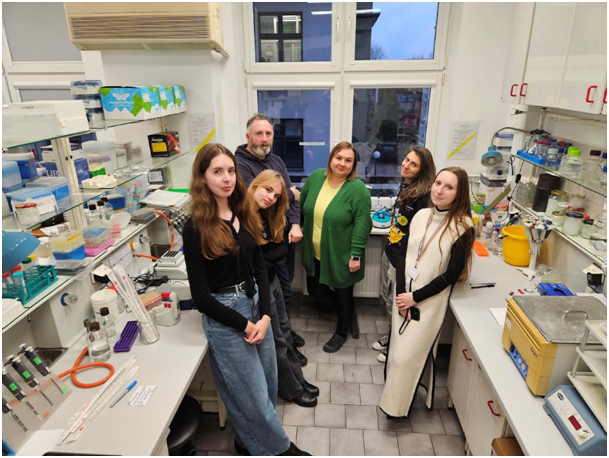
GROUP MEMBERS
Head of the Group:
Daria Zdżalik-Bielecka, PhD (e-mail: d.zdzalik-bielecka@uw.edu.pl)
Assistant Professors / Postdoctoral Researchers:
Małgorzata Szostakowska-Rodzoś, PhD (e-mail: m.szostakowska@uw.edu.pl)
Konrad Kosicki, PhD – DNA Repair (e-mail: km.kosicki@uw.edu.pl)
PhD Students:
Weronika Tokarska-Domżałowicz (e-mail: w.tokarska-domzalowicz@uw.edu.pl)
MSc and BSc Students:
Marcelina Cupiał
Maryna Lutsenko
Aleksandra Matosek
GRANTS
“Invadopodia in AXL-driven cancer invasion and drug resistance” — OPUS-25 grant, National Science Centre (2023/49/B/NZ3/03704; 2024–2028), Principal Investigator: Dr. Daria Zdżalik-Bielecka
SELECTED PUBLICATIONS
1. Tokarska-Domżałowicz W i Zdżalik-Bielecka D “At the intersection of immunology and oncology: TAM receptors in the regulation of immune responses and tumorigenesis-related processes” [Article in Polish] Postępy Biochemii, 2025, 71(3).
2. Poświata A, Kozik K, Miączyńska M, Zdżalik-Bielecka D „Endocytic trafficking of GAS6-AXL complexes is associated with sustained AKT activation.” Cell Mol Life Sci. 2022; 79(6):316.
3. Zdżalik-Bielecka D, Kozik K, Poświata A, Jastrzębski K, Jakubik M, Miączyńska M „Bemcentinib and Gilteritinib Inhibit Cell Growth and Impair the Endo-Lysosomal and Autophagy Systems in an AXL-Independent Manner.” Mol Cancer Res. 2022; 20(3):446-455.
4. Zdżalik-Bielecka D, Poświata A, Kozik K, Jastrzębski K, Schink KO, Brewińska-Olchowik M, Piwocka K, Stenmark H, Miączyńska M „The GAS6-AXL signaling pathway triggers actin remodeling that drives membrane ruffling, macropinocytosis, and cancer-cell invasion.” PNAS 2021; 118(28):e2024596118.
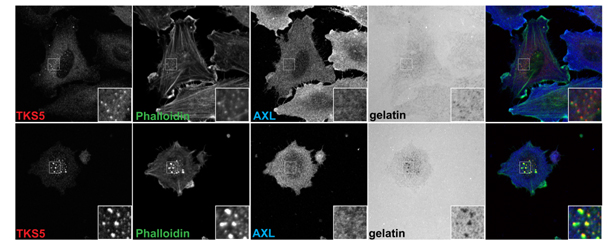
Formation and proteolytic activity of invasive protrusions, termed invadopodia, in unstimulated (upper panel) and AXL ligand–stimulated (GAS6; lower panel) LN229 glioblastoma cells. Invadopodia markers: TKS5 and actin (visualized using phalloidin). Image: Agata Poświata.